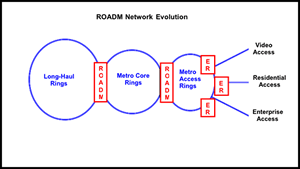
In the eight or so years of previous ROADM history, we have witnessed a continuum of advancing capabilities and technologies in ROADMs. In the last 2-3 years, several companies have introduced products that are edge ROADMs (although the name is only beginning to be standardized) with reduced capabilities and reuse of existing technology on a cost-reduced basis.
Now, the ROADM has become a standard part of long-haul networks — to be included as a matter of course in any new network — and it has become a major update objective for existing networks. They have also become important in metro networks. In addition to the maturity of application, ROADMs have also developed a third generation technology base — the wavelength selective switch (WSS) — that has quickly become the "gold standard." Now the new application that is driving cost savings is the use of low-cost ROADMs at the edge of the network.
Continuing the trend, carriers are now interested in extending that control capability to the ends of the network. The ever-increasing demand for bandwidth at the ends of the network, mostly exemplified by the overwhelming importance of video, makes the extension of network control capabilities inevitable.
This report details where the industry is in beginning the new ROADM revolution from the “Core to the Edge.” This revolution will bring ROADMs to virtually every central office and head-end in the U.S., and in many parts of the world. The forecasts included herein detail that expansion.
Our focus for this report is the edge ROADM. There are forecasts, application sketches, complete vendor coverage, technology discussions, etc. — all aimed at the edge ROADM. While the edge ROADM is our focus, the report also contains a complete update on all aspects of core and metro ROADMs, as well. including forecasts (with component forecast separately provided), application information, full technology discussions, and complete vendor information.
A number of technologies are involved in the ROADM. The report presents several different architectures, with an emphasis on edge ROADMs and WSSs, but also including the switch version and the broadcast version. This report also discusses the latest in developing trends and architectures for ROADMs, including colorless, directionless, contentionless, and gridless. Technologies involved in each approach are described. The vendors associated with the various approaches are identified, and market forecasts are developed on a component/subsystem level as well as on a system level.
There are many applications for the ROADM. The applications of various-degree nodes ("two-degree nodes," for example, have two fiber routes, three-degree have three, etc.) that are common in the network are depicted. As will be noted, some of these applications will have particular use in merging the long-haul networks of the IXCs and the metro networks of the RBOCs. The new application in this report is the network edge.
The main market driver for ROADMs is the desire by the carriers to save operating expenses. The new video thrusts by the major combined RBOCs are a new driver to ROADM deployment. These companies are in the process of deploying nationwide networks to deliver video on their fiber access local networks. ROADMs are the perfect adaptation to control these video distribution services. In addition, the forecasted increase in wavelength services is going to greatly facilitate the deployment of networks based on ROADMs. Finally, the ever-increasing demand for bandwidth by the end user is mandating that ROADMs penetrate the network from core to end.
This report investigates the systems known as reconfigurable optical add/drop multiplexers (ROADMs). These devices are currently available in equipment from several major equipment vendors, and have been for about eight years. These products are based on a variety of subsystem technologies that have been developed largely by small startup companies. The main focus of this report (in addition to ROADMs in general) will be on the new application of edge ROADMs. We will also continue our focus from our 2008 ROADM effort on WSS-based ROADMs. Included in this report are the most extensive forecasts for ROADM-related data available. They are all based on a 2015 time horizon, and are on a system as well as component level. The forecasts are provided for U.S. and world bases.
Table of Contents
Table of Contents
Table of Figures
The Lightwave Network Series of Reports
The Lightwave Network
The Lightwave Series of Reports
General Market Reports
Specific Systems Reports
General Reports on the Network
Executive Summary
Introduction
This Report
ROADMs Provide SONET-like Control in Optical Networks
Defining ROADMs
Types of ROADMs
Pre-ROADM Approach — OXC-Based Approach to ROADMs
First Generation ROADM — PLC-Based ROADMs
Colorless vs. Colored Ports
Other Names
Benefits and Problems with PLC ROADMs
Vendors of PLC ROADMs
The Second-Generation ROADM — Blocker-Based ROADMs
Other Names
Alternative Designs for Blockers
Problems with Blocker-based ROADMs
Vendors of Blocker ROADMs
Third-Generation ROADM — Wavelength Selective Switch (WSS)
Other Names
Vendors of WSS ROADMs
Problems and Benefits of WSS ROADMs
Fourth-Generation ROADMS — Edge ROADM (ER)
Vendors of Edge ROADMs
Summary of ROADM Features by Utilization
Summary of ROADM Types by Generation
Summary of ROADM Description
The advantages of ROADMs
ROADM Applications
Degree-two Node Applications
Typical EDFA (Amplifier) Site Replacement
Degree-three and Multiple-degree Applications
Approaches to the New RBOC-IXC Merged Network Examples
The WSS Solution to Joining Rings
Edge ROADM Applications
New Directions for ROADMS
Colorless
Directionless
Advantages of Colorless/Directionless Systems
Contentionless
Gridless
Questions Remain
Business Case for ROADMs
Opex Savings
Capex Savings
The RBOC-IXC Merger Driver
OAM&P Software
Wavelength Services
IPTV Networks
Vendors of the IPTV Networks
AT&T
Verizon
Comcast
Edge Applications — the New ROADM Driver
Market Forecast
Forecast Methodology
Model for Forecast Core and Metro ROADMs
2005
2006
2008
2010
Assumptions of Model
Model for Forecast — Edge ROADMs
Forecast Update
Background for these forecasts.
General Economic Background
Telecom Economic Background
Possible Positives for Telecom in 2010
Systems
Systems — US Forecast
US Edge ROADMs
US Market Forecast
Systems — World Forecast
World System Forecast
World Edge Systems Forecast
World Market Forecast
Components
Assumptions for Component Forecasts
Pricing for Components
Components — US Forecast
Blocker US Market Forecast
Mux/Demux US Market Forecast
Tunable Laser US Market Forecast
Tunable Filters US Market Forecast
Switch Points US Forecast
Monitor Points US Market Forecast
WSS Units US Market
Total Components US Market Forecast
Components — Global Forecast
Blockers Global Market Forecast
Mux/Demux Global Market Forecast
Tunable Laser Global Market Forecast
Tunable Filter Global Market Forecast
Switch Points Global Market Forecast
Monitor Points Global Forecast
WSS Units World Market
Components Total Global Forecast
ROADM Vendors
Leading Vendors
Major Contracts
Component/Subassembly Vendors
Component/Subassembly Vendor Listing
AC Photonics, Inc.
Active Optical MEMS, Inc.
Aegis Lightwave, Inc.
Agiltron, Inc.
Alliance Fiber Optic Products
ANdevices (Enablenace Technologies)
AOC Technologies
Auxora, Inc.
Avanex Corporation
Avo Photonics
Capella Photonics
Clarendon Photonics
CoAdna Photonics
Corning
Corrigent
Cube Optics AG
DiCon Fiberoptics
DuPont Photonics Technologies
Emit Technology Co. Ltd.
Enablence Technologies
Engana Pty. Ltd. (Optium Corp.)
Fibernett. Co. Ltd.
Finisar Corporation
FOCI Fiber Optic Communications, Inc.
Guangzhou Yongda Optical Comm. Tech. Dev
Hitachi Chemical Co. America Ltd.
Hitachi Cable
Hitachi Metals America, Ltd.
Infineon Technologies
Inplane Photonics, Inc.
Intel Corporation
JDS Uniphase
Kaiser Optical Systems, Inc
Kamelian (Amphotonix Ltd)
Lambda Optical Systems
LightComm Technology
LIGHTCONNECT Inc (NeoPhotonics)
Lightwaves2020 Inc.
Lynx Photonic Networks
Mahi Networks (Meriton) - Xtera
Metconnex (JDSU)
NeoPhotonics
Network Photonics (Not in Operation)
OLYMPUS MICROSYSTEMS AMERICA INC.
O-Net Communications Ltd.
Oplink Communications, Inc.
Optium Technologies
Optoplex
OpTun Inc. (NEoPhotonics)
Osaki Electric Co., Ltd.
Paxera Corp. (neoPhotonics)
Polychromix
Redfern Optical Components Pty Ltd.
SDO Communications Corp.
Shenzhen Hi-Optel Technology Co. Ltd.
Silicon Light Machines (Cypress Semiconductor)
Sinclair Manufacturing Company
SpectraSwitch
Stratos International, Inc.
TeraXion Inc.
TheFibers Inc.
Topfiber Technology
TransOptix
Valdor Fiber Optics
Xerox
Xtellus
System Vendors
System Vendor Listing
Adva Optical Networking
Alcatel-Lucent
Avvio Networks
Ciena
Cisco
ECI
Ericsson
Fujitsu
Infinera
Huawei Technologies
Mahi Networks (formerly Photuris) — Meriton – Now Xtera
Marconi Corporation plc (Ericsson)
Meriton Networks
Movaz Networks (ADVA)
NEC America Inc.
Nistica
Nokia Siemens (NSN)
Nortel
OpVista Inc.
Tellabs
Tropic Networks (Alcatel-Lucent)
Appendix I — ROADMs and Other Switches — A Taxonomy
Switches by Any Other Name
"Switch" Types
Classes of Transparent Optical Switches
FXC
WSXC
WICX (Wavelength Independent Cross-Connect)
Routers
TDM Switches
ATM
IP Switches
DACS
DACS/ROADM Relationship
Drivers to DACS Deployment
ADMs — The Key SONET Functionality
OADMs
Appendix II — Technologies for ROADMs
Switches and Blocker
MEMS
Approaches to MEMS
Digital Approach
Analog Approach
One Dimension MEMS
Grating Light Valve (GLV)
Planar Lightwave Circuits
Liquid Crystal
LQ Uses
Fiber Bragg Grating
Mux/Demuxes
AWG Devices
Etched Waveguide Devices (Planar Waveguide Devices)
Tunable Lasers
Monitor Points
Technology Summary
Summary of Features by Class
Importance of Tunable Lasers
Developers and Vendors of Tunable Lasers
Tunable Lasers Vendors List
ADC
Altitun AB (ADC)
Alcatel-Lucent
Bookham (New Focus, Inc.)
Corning
Hewlett-Packard
Intel
JDS Uniphase
Marconi
Nortel
Paxera
Pirelli Broadband Systems
Santur
Appendix III — Listing of Acronyms
Table of Figures
Figure 1: Lightwave Network
Figure 2: ROADM General Configuration
Figure 3: Fully Switched Approach to OADM
Figure 4: PLC Based ROADM
Figure 5: Detailed 'Blocker' ROADM Architecture
Figure 6: Alternative M-Z Diode-based Broadcast ROADM
Figure 7: WSS Structure
Figure 8: WSS-based ROADM
Figure 9: WSS-based Multi-degree Node Interconnection
Figure 10: Typical Blocker ROADM
Figure 11: WSS Added to Blocker
Figure 12: Summary of ROADM Types by Utilization
Figure 13: Four Generations of ROADMs
Figure 14: Economic Advantages of ROADMs
Figure 15: Three-Amp DWDM System
Figure 16: 3R Intermediate Access Solution
Figure 17: Use of ROADM for Intermediate Site Access
Figure 18: Degree Three Node Example
Figure 19: Joining Two Rings
Figure 20: Using Core Routers in Degree-three Nodes
Figure 21: Using an OXC in a Degree-three Node
Figure 22: Using a ROADM for the Degree-three Node
Figure 23: Using ROADMs for Joining Rings
Figure 24: WSS Approach to Interconnecting Rings
Figure 25: ROADMs across the Network
Figure 26: Example of Edge ROADM Application — Telco
Figure 27: Example of Edge Router used by Cable Company
Figure 28: Forecast for Wavelength Services
Figure 29: IPTV Video Network
Figure 30: ROADM System Unit Forecast — US
Figure 31: US Market — Change in Predominant Type of ROADM over Time
Figure 32: US Edge ROADMs Systems
Figure 33: Price Forecast for ROADMs
Figure 34: ROADMs Market Forecast — US
Figure 35: OADM vs. ROADM Market — US
Figure 36: US ROADM as a Percent of Global Usage
Figure 37: ROADM Systems — Global
Figure 38: World Market — Change in Predominant Type of ROADM over Time
Figure 39: US Portion of World Edge ROADM Market
Figure 40: World Systems — Edge ROADMs
Figure 41: ROADM Market Forecast — Global
Figure 42: US Systems by Type
Figure 43: PLC Version of the ROADM
Figure 44: Broadcast/Blocker Version of the ROADM
Figure 45: WSS Typical for Component Count
Figure 46: Component Count for Each Type of ROADM
Figure 47: Component Price Table
Figure 48: Components — US Units
Figure 49: Blocker US Market Forecast
Figure 50: Mux/Demux US Market Forecast
Figure 51: Tunable Laser US Market Forecast
Figure 52: Tunable Filters US Market Forecast
Figure 53: Switch Points US Market Forecast
Figure 54: US Market — LC Switch Points
Figure 55: US Market — MEMS Switch Points
Figure 56: Monitor Points US Market
Figure 57: US Market — WSS Units
Figure 58: Total Components US Market Forecast
Figure 59: Components Units Global Forecast
Figure 60: Blocker Global Market Forecast
Figure 61: Mux/Demux Market Forecast
Figure 62: Tunable Laser Global Forecast
Figure 63: Tunable Filters Global Market Forecast
Figure 64: Switch Points Global Market Forecast
Figure 65: World LC Switch Point Market
Figure 66: World MEMS Switch Point Market
Figure 67: Monitor Points Global Forecast
Figure 68: World WSS Units Market
Figure 69: Components Total Global Forecast
Figure 70: U-Verse: FiOS ROADM Vendors
Figure 71: Summary Table — Sub-system Vendors
Figure 72: Summary Table — System Vendors
Figure 73: ROADM Concept
Figure 74: Example of FXC Class Fiber-to-Fiber Application
Figure 75: Example of FXC Application at 1310 nm
Figure 76: Example of WSXC Application
Figure 77: Example of WICX Application
Figure 78: SONET ADM
Figure 79: OADM
Figure 80: Improved OADM
Figure 81: OADM with Limited Switching
Figure 82: Detailed PLC ROADMs
Figure 83: Detailed Blocker ROADM
Figure 84: MEMS Layout
Figure 85: Sketch of Two Dimensional MEMS
Figure 86: Sketch of Multi-Dimensional MEMS
Figure 87: 1D MEMS
Figure 88: Sketch of Liquid Crystal Technology
Figure 89: Planar Waveguide Demux
Figure 90, Technologies' Summary
Figure 91: Table of Switch Classes — Summary of Features
Figure 92: Example of Use of Tunable Laser in Transparent OXC