Overview:
The year 2004 has seen the return of the telecom economy. It is not what it was, but telecom is growing again, and new and innovative communications solutions are being deployed. In addition, we are seeing major changes beginning in the industry that are going to result in a new telecom economy. These changes are evidenced in the industry structure by titanic struggles (often for their very existence) among companies that not long ago where considered indestructible. These are struggles amongst the major classes of carriers (telcos, IXCs/CLECs, cable companies, and satellite companies) for 'their' place in this new telecom economy. The irony of this struggle is that each of these major players seems to think that its 'place' is the current major market of one (or more) of the others. The results of these struggles are going to be a re-structuring of the industry. Our latest report on the Telecom Economy (it is the eighth market report in the Lightwave Series) provides not only extensive forecasts of the economy (all forecasts are 2004 through 2009) but is it also defines the new nature of the industry. The winners and losers are identified and the rationale for their performance is detailed.
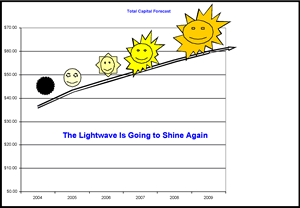
The following is our forecast for capital expenditures:
Click for larger image.
The other major change that constitutes this new telecom economy is a physical network change. The telecommunications network is dramatically changing to an IP (Internet Protocol) driven environment. It is changing from SONET to DWDM, and a sophisticated, later version of DWDM at that. Control of the network is taking on a significant role at several different levels. Major networks are already in place that use MPLS (Multiprotocol Level Switching) and we are going to see ROADMs (Reconfigurable Optical Add Drop Multiplexers) controlling network in very short order. The class five central office has been the cornerstone of our network for many decades. It is now almost obsolete. Many of the concepts that have long driven almost every branch of telecommunication is becoming obsolete, and much of this has happened while the industry was in its worst recession. We definitely believe that the bursting of the telecom and Internet bubbles in the early 2000's and the maturing of selected technologies have led to a 'new telecom.'
This new business is characterized as follows:
- Very lean - much less labor intensive.
- Moving toward an IP-based technology. Multiple, non-traditional competitors, however a handful will retain disproportionate market power. Many of the old products (voice, long distance, etc.) are commodities. New products involve new packaging (bundling), data-based services, and high-speed access.
- Multiple, competitive last-mile networks.
To help our readers understand the impact of this new telecom environment this report will provide:
- Discussion of the current telecom market place and the relative sizes of the various sectors.
- New forecasts for the overall telecom economy.
- Forecasts for revenue growth (or loss) for various sectors.
- New forecasts for high-speed (h-s) access growth.
- Forecast of PC and high-speed access penetration.
- Discussion of capital drivers.
- Discussion of major capital programs, including FTTP, VoIP and network modernization.
- New forecasts for capital expenditures.
- New forecasts for network traffic growth.
- Discussion of the impact of the new telecom on selected companies.
- Identification of likely mergers and of the new structure of the telecom industry.
Table of Contents
TABLE OF CONTENTS
TABLE OF FIGURES
THE LIGHTWAVE NETWORK SERIES OF REPORTS
EXECUTIVE SUMMARY
INTRODUCTION
MARKET CONDITION
The Competitive Landscape - Threats in Every Direction
RBOCs vs. the CLECs (IXCs)
The RBOC Counterattack - Long Distance
RBOCs vs. Cable Companies
Cable Companies vs. Satellite Companies
REVENUES OF THE VARIOUS TYPES OF CARRIERS
Market Share Forecast
Market Forecast Methodology
Changes in Market Share
Relationship to Company Strategies
CAPITAL DRIVERS AND FORECASTS
Categories of Capital Expenditures
Capital Drivers
H-S Accesses
"Up-Network" Traffic Implications of High-Speed Accesses
H-S Access Forecasts
Traffic Forecasts Programs
FTTx
VoIP
Network Modernization
ROADMs
Tunable Lasers
Summary of Capital Forecasts for Programs
Capital Forecasts
Historical Patterns
Forecasted Capital
CLASS OF CARRIER AND SELECTED COMPANY IMPACTS
The IXCs
The Most Likely Scenario
BellSouth Buys AT&T
SBC Buys MCI
Verizon Buys Sprint
Another Possibility
Cable Companies
Telcos
Summary of Company Impacts
OVERALL FORECAST SUMMARY
APPENDIX I - LISTING OF ACRONYMS
APPENDIX II - DATA TRAFFIC FUNDAMENTALS
Internet Traffic Calculations
Bits and Bytes
Transfer Rate
Busy Hour Traffic
Protocol Efficiencies
Statistical Multiplexing
Peaking
Summary of Concepts
APPENDIX III - DSLAM TRAFFIC CALCULATION EXAMPLE
Illustration of Data Node Calculation
Transfer Rate and Busy Hour
Protocol Inefficiencies
Statistical Multiplexing
Peaking
A Numerical Example
|