|
|

|
|
|
Overview
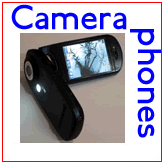
Sharp and J-Phone introduced the first camera-phone (J-SH04) in November 2000. Today (January 2004) about 60% percent of mobile phones in Japan are camera phones and we expect that in 2005 the market penetration will almost reach 100%, i.e. almost all mobile phones in Japan will be camera phones. Top range models have 2 Megapixel cameras and autofocus and represent disruptive innovation for the imaging industry.
The present report describes Japan's market for camera phones and the Japanese camera phone industry quantitatively and qualitatively in approx. 140 slides with more than 80 photographs.
Table of Contents
-
1. Executive Summary
-
2. Camera phones: distruptive innovation for photography
The innovator's dilemma
Disruptive innovation, disruptive technologies
Consequences
Video
-
3. Camera phones - An overview
What are camera phones?
Short J-Phone shamail history
- 4A. User numbers and statistics, estimated carrier sales
Sha-mail, foto-mail and i-shot usage
Camera phone numbers for Japan's carriers (data for 2001-Dec 2003
DoCoMo's i-shot as the fourth mover
About 60% of cell phones are camera phones in Japan (total number and number by carrier, data for 2001-Dec 2003)
How many pictures do subscribers send?
How much money do carriers make? (estimated income of DoCoMo from transmission fees for images per month)
-
4B. Camera phone handset market in Japan
Camera handsets
Japan's market for mobile phones with camera: market size, and estimation until 2004
Market shares of camera phone market in Japan for individual camera phone manufacturers (for 2001 and 2002)
Mobile internet and camera handsets - trends towards the "sweet spot"
Trends of mobile phones in Japan: weight and volume data and analysis for the period 1990-2006 for 2G and 3G phones
Trends of battery standby time in Japan: 1990-2006 for 2G and 3G phones, data and analysis
JAVA
Typical camera phone characteristics: high-end compared to a typical low-end camera phone (data January 2004)
DoCoMo's 505i series characteristics: F505i, D505i, N505i, SO505i, SH505i, P505i (start of 505i series: June 2003
DoCoMo's 505iS series characteristics: F505iGPS, D505iS, N505iS, SO505iS, SH505iS, P505iS (start of 505iS series: Dec 2003
DoCoMo's FOMA 900 series characteristics: D900i, F900i, N900i, P900i, SH900i (start of FOMA 900i series: planned for Feb 2004
-
5A. Description of 3G Infobar Movie camera phone
Description and key characteristics
Photographs of the phone
The KDDI/AU design project
Sample picture taken by the phone
-
5B. Description of F505i camera phone
Description and key characteristics
Photographs of the phone
Sample picture taken by the phone
-
5C. Description of P505iS camera phone
Description and key characteristics
Photographs of the phone
-
5D. Description of N504iS camera phone
Description and key characteristics
Photographs of the phone
Sample picture taken by the phone
-
5E. Description of P2102 FOMA 3G video camera phone
Description and key characteristics
Photographs of the phone
Sample picture taken by the phone
-
5F. Selected other camera phones in Japan and sample photographs
The J-Phone J-D05 by Matsushita
Selected images by J-Phone sha-mail phones
Selected images by DoCoMo i-shot phones
Selected images by AU/KDDI phones
Images by TuKa T21 phone
-
6. Picture Mail and GPS Demonstration
Picture mail and GPS: description, analysis
EXAMPLE: Demonstration of Picture mail & GPS by AU/KDDI (model 5302CA)
EXAMPLE: KDDI/AU Infobar (Nishikigoi version)
-
7. Movie mail
Video/movie mail description
Screen images: J-Phone/SANYO Phone J-SA51
Overview of different mobile video systems in use in Japan
Nancy image compression format: characteristics and analysis
-
8. Technical aspects, description, trends, limitations and future scope
Technical aspects
Trends and future
Limitations
-
9. Cameras enable data input to mobile phones via 2D barcode (QR code)
2D barcode (QR code)
Example: payment at a store with 2D barcode coupon
2D barcodes (Q codes) and camera phones
-
10. The camera phone industry structure and segmentation
Industry structure and segmentation
Services and opportunities
Example: sending images between networks - KDDI's team factory service
Shamail websites and business opportunities
J-Phones "@shamail album "
Example: Waku-Waku iPrint Service
Example: Photo-Album storage & printing
-
11. Printers
Printers for individual use
-
12. Photo finishing stations
Images and examples of fee operated public photofinishing stations
-
13. Camera phones: global expansion and trends
-
14. Competitive environment in Japan - the Carrier perspective: DoCoMo, AU/KDDI, J-Phone/Vodafone
Lively competition created the world's most advanced mobile communication landscape in Japan - schematic view of Japan's telecommunication carrier industry (updated Oct 2003)
Four groups of companies compete for 65 million wireless internet users in Japan
Three groups compete in Japan's mobile phone market: NTT-DoCoMo, KDDI (AU), and J-Phone: mobile phone subscriber numbers for individual carriers (data: 1998 - 2003)
Market shares (1998 - 2004)
Mobile internet subscriber numbers (imode, Jsky, EZweb, H, period 1999-2004)
Brief description of carriers
Comments
Historic development
-
15. Some characteristic differences between mobile communications
industry in the "GSM-world" compared to Japan
characteristic differences (table)
Churn (prepaid, subscription) period: 1996-2001
ARPU: comparing DoCoMo and Vodafone Germany
DoCoMo's churn compared to competitors Vodafone (Japan) and KDDI/AU, and global Vodafone (data for 1996-2003)
ARPU for different European countries (both prepay and subscription shown) compared with Japan's ARPU (only subscription shown)
ARPU 1999-2003 (total ARPU and data ARPU for DoCoMo and competitors)
Japan versus GSM world and what it means for Camera phones
Japan versus GSM world - trends (tables)
-
16. Summary
|
|
|